Back to Basics is a weekly feature that highlights important but
possibly overlooked information that any EHS professional should know.
This week, we examine OSHA’s standards for woodworking safety.
Woodworkers can be found in a number of different industries.
According to the Bureau of Labor Statistics (BLS), most woodworkers are employed
in manufacturing industries, and they are responsible for making a
variety of products, such as cabinets and furniture, using wood,
veneers, and laminates. Working conditions vary, but many woodworkers
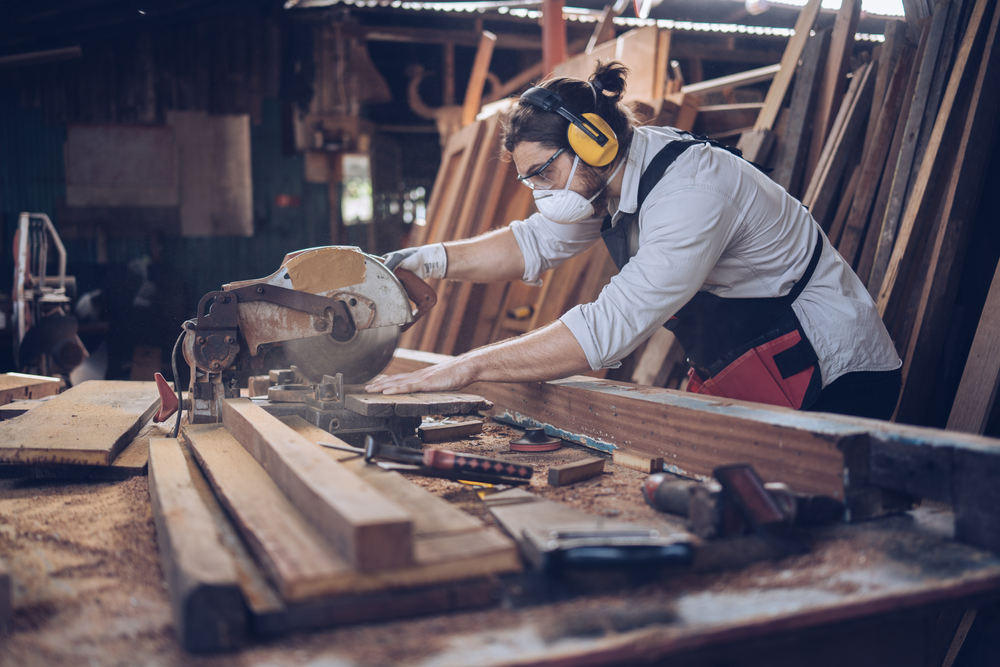
are exposed to hazards such as machinery noise and wood dust. According to OSHA, woodworking operations can be hazardous, especially when machines are used improperly or without proper safeguards.
The guidelines for woodworking can be found in OSHA’s standards
for general industry, specifically in the subparts for walking and
working surfaces, ventilation, occupational noise exposure, hazardous
materials, personal protective equipment (PPE), lockout/tagout, powered
industrial trucks, and machinery and machine guarding.
Hazards
Woodworkers operating equipment often suffer injuries such as laceration, amputation, severed fingers, and blindness, according to OSHA. They face machine hazards
at the point of operation and when there are pinch points and rotary
and reciprocating movements. Workers also deal with kickbacks, flying
chips and materials, tool projections, fire and explosion hazards, and
electrical hazards.
OSHA provides two examples
of potential woodworking machine hazards. If not properly grounded, the
metal framework of a circular saw could become energized and possibly
electrocute and employee. If a worker’s hands were to contact a saw
blade, they could have one or more fingers cut off.
Woodworkers face health hazards such as skin and respiratory diseases
due to working with wood dust and chemicals used for finishing
products. OSHA says
most health hazards are associated with long-term exposure to certain
substances or to excessive noise levels or vibrations. Some kinds of
wood dust can cause allergic reactions, and saw dust is a group A
carcinogenic.
Finishes, coatings, adhesives, and solvent vapors can contain
chemicals that affect the central nervous system, which can cause
headaches, nausea, and dizziness. Exposure to turpentine can result in
temporary irritation of the eyes and skin, and even kidney and bladder
damage.
Equipment hazard solutions
Employers can implement several procedural and administrative controls
in order to protect their workers from equipment hazards, according to
OSHA. Workers should be using appropriate equipment for the job, and
only using machines for work within the rated capacity specified by the
machine manufacturer.
Employers should train workers on machine use and allow only trained
and authorized workers to operate and maintain the equipment. Workers
must be able to understand the purpose and function of all controls on
the machine, how to stop the equipment in an emergency, and the safety
procedures for special set-ups. OSHA says operator training should
include hazards associated with the machine, how the safeguards protect
workers from the hazards, the circumstances under which the guard can be
removed, and what to do if the guard is damaged or not functioning
properly.
Managers should inspect the equipment and guards frequently to ensure
that the operator and machine are equipped with the safety accessories
of the job, the machine and safety equipment are in proper working
condition, and the machine operator is properly trained. The inspections
must be documented, and the documentation should identify the machine,
inspection date, problems noted, and corrective action taken.
Equipment must only be used when guards are in place and in working
order, and when guards cannot be used, combs, featherboards, or suitable
jigs for holding the stock must be provided. Employees must be provided
with push sticks or other hand tools so that their hands are away from
the point of operation when they work on small pieces of stock.
Electrical hazard protection
All electrical installations must comply with OSHA’s electrical
standards, including the following requirements. All metal framework on
electrically driven machines must be grounded, including the motor,
motor casing, legs, and frame. All circuit breakers and fuse boxes must
be labeled to indicate their purpose, and electrical cords, cables, and
plugs must be kept in good repair.
Junction boxes, outlets, switches, and fittings must be covered, and
all electrical components must be approved by a Nationally Recognized
Testing Laboratory. All machines must have a main power disconnect for
lockout/tagout.
Additionally, according to OSHA, all machines should have:
- A magnetic switch or other device to prevent an automatic restarting of the machine after a power failure.
- An emergency stop device within reach of operators working in the normal operating position.
- Clearly marked controls that are within easy reach of the operator and away from the hazard area.
Wood dust
Employers can protect workers from wood dust using local exhaust ventilation (LEV), which removes dust at or near the source. According to OSHA,
LEV systems can often be integrated with machine guards. Exhaust hoods
must be located as close as possible to the emission source, either on
the woodworking machinery itself or near the machine. The local exhaust
systems must also have an efficient air cleaning device.
LEV systems must be maintained by checking and cleaning ducts and
dust collectors at regular intervals. The ducts must be inspected to
ensure that they are not loose, broken, or damaged, and V-belts need to
be checked on the drive units of belt-driven exhaust fans for slippage
or breakage. OSHA provides a list of LEV recommendations for individual
machines, including circular saws, band saws, jointers, shapers, planers
and moulders, lathes, sanders, and routers.
Noise and vibration
Volume and duration are the primary factors that determine if noise
is hazardous. The longer the duration and the louder the noise, the
greater potential for hearing loss. Employers can reduce noise levels
through three basic approaches to controlling noise:
- Noise source controls
- Noise path controls
- Hearing protection
Noise source controls provide the most effective means of protection,
since they actually reduce the amount of noise generated in the
workplace, OSHA says. After exhausting source control options first,
employers should turn to path controls, and then finally, hearing
protection devices.
For vibration hazards, vibration isolators or damping techniques on equipment offer the most effective protection. OSHA recommends
isolating machine vibrations from the surface if it is mounted or by
use of vibration isolation mounts. Vibrating panels of machine housings
and guards can be controlled by applying effective damping materials,
such as felts, liquid mastics, and elastomeric damping sheets, to the
panels.
A knowledgeable person should determine the correct type and quantity
of damping material to use for a particular machine. Factors to
consider include the frequency emitted by the machine, the noise
reduction level desired, and the weight and size of the machine. OSHA
says a good rule to follow is that the damping layer should be the same
thickness as the surface being treated.
The World's Largest Collection of 16000 Woodworking Plans!


 We are part of The Trust Project.